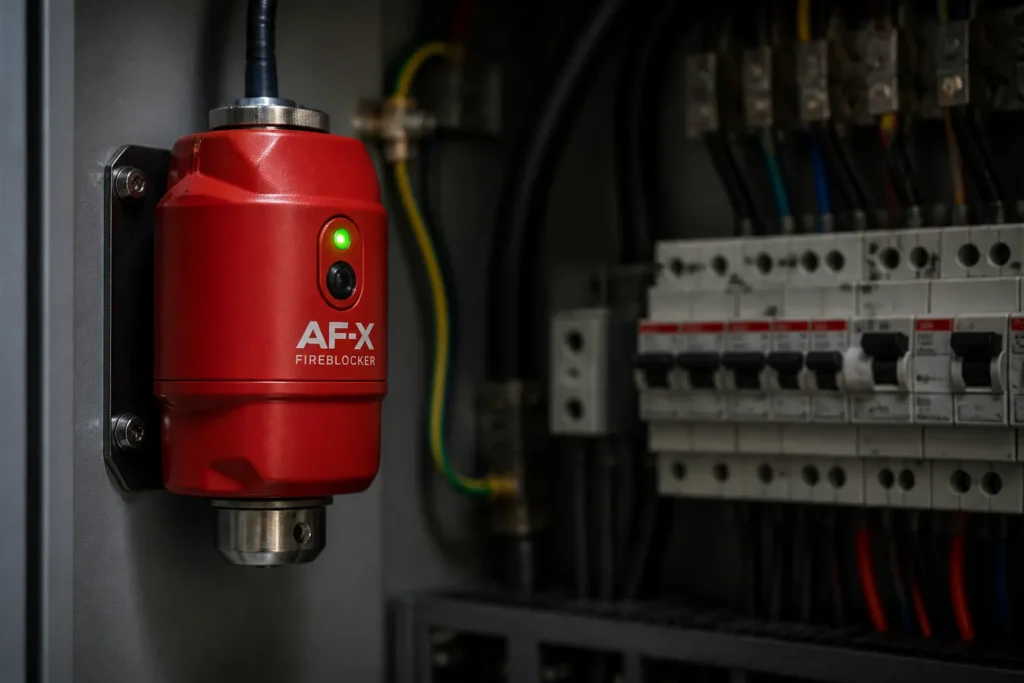
AF-X Fireblocker is a Dutch manufacturer of condensed potassium-based dry aerosol suppression units. The systems are produced by Aerospace Propulsion Products (APP), part of ArianeGroup (a joint venture of Airbus and Safran), and sold through a global network of distributors via project-specific quotations. AF-X Fireblocker systems are certified to key international standards, including ISO 15779, EN 15276, NFPA 2010, UL 2775, KIWA, and IMO MSC/Circ.1270 (BSI certificate BSI/MED/3.46/806371).
What makes a suppression system automatic?
An automatic fire suppression system detects a fire and activates without human intervention. This is achieved through sensors that detect heat or smoke and a connected activation mechanism. Depending on the design, an automatic system can operate as a standalone unit or integrate with a central fire alarm panel for monitoring and a coordinated response. Read the full overview of automatic aerosol fire suppression
Detection and Activation Components
AF-X Fireblocker systems use various components for detection and activation, tailored to the specific application:
| Component | Senses / Function | Typical Use | Requires Control Panel? |
|---|---|---|---|
| Linear Heat Detection (LHD) Cable | Detects heat at any point along its length | Electrical cabinets, cable trays, engine compartments | Yes |
| Bimetal Switch | Activates at a fixed temperature | Small enclosures, standalone object protection | No |
| Smoke Detector Loop | Detects smoke particles in the air | IT & server rooms, technical rooms, control rooms | Yes |
| DECU3 Fire Extinguishing Panel | Manages detection loops and activation signals | Larger or multi-zone system installations | Is a control panel |
| Activation and Delay Buttons | Provides manual system activation or override | Control rooms, facility entry points | Yes |
| Sounder and Warning Beacon | Provides audible and visual alerts of system activation | Occupied spaces, industrial areas | Yes |
| Manual Call Point | Allows for manual activation of the fire alarm system | Building egress routes, integrated systems | Yes |
What are the specifications of AF-X Nano generators?
AF-X Fireblocker offers compact aerosol generators, such as the Nano CXXS and CXS models, for protecting small enclosures. These units differ in agent weight and protected volume, allowing for precise application inside equipment like electrical cabinets for fire suppression at the source. Explore available AF-X Fireblocker system types and options
The technical specifications for two models in the Nano series are:
| Model | Aerosol Agent | Protected Volume | Discharge Time | Max. Install Height | Dimensions (L x Ø) |
|---|---|---|---|---|---|
| Nano CXXS | 30 g | 0.4 m³ | Under 20 seconds | 1.5 m | 18 cm x 3.8 cm |
| Nano CXS | 60 g | 0.8 m³ | Under 40 seconds | 2.0 m | Not specified |
Where are automatic aerosol suppression units used?
Automatic aerosol suppression systems are used in critical environments where water or gas could cause significant collateral damage or pose a safety risk. They are ideal for protecting enclosed spaces and specific high-risk equipment where business continuity is essential. The compact, pressureless design allows for installation in areas with limited space without requiring major structural changes. See real‑world scenarios where AF-X is the preferred solution
Common applications for AF-X Fireblocker units include:
- Electrical cabinets and switchgear
- Technical rooms and Motor Control Centers (MCCs)
- IT and server rooms
- Industrial installations and machinery
- Lithium-ion Energy Storage Systems (ESS/BESS)
- Marine engine rooms and control spaces
- Offshore modules and equipment
- Wind turbines (nacelle and tower base)
- Automated parking garages
What factors determine the cost of an aerosol fire suppression system?
The total cost of an AF-X Fireblocker system is project-specific and depends on the scale and complexity of the required protection. Key drivers include the volume of the protected space, the number of aerosol generators, and the detection system’s sophistication. Aerosol systems often have a lower total cost of ownership than traditional gas or water systems due to simpler installation and maintenance. Learn the installation and commissioning best practices
Primary cost drivers include:
- Number of generators: Determined by the volume of the protected space.
- Detection and control system: A simple thermal switch is less expensive than a multi-zone control panel with smoke detectors and alarms.
- Project type: Costs can differ between a retrofit into existing infrastructure and a new build installation.
Aerosol systems offer cost advantages because they do not require heavy piping, pressure-relief vents, or a separate room for gas cylinders. The generators also have a 15-year operational lifespan with only visual maintenance checks required, which significantly lowers long-term costs.
Note: AF-X Fireblocker does not publish list prices. All systems are engineered for specific applications, with pricing provided via a detailed quotation through an official distributor.
How can I obtain an AF-X Fireblocker system?
To obtain an AF-X Fireblocker system, contact the company directly or an authorised distributor in your region. The process starts with a technical assessment of your requirements to design the correct system configuration. Based on this analysis, a formal project quotation is prepared, detailing the proposed solution, components, and associated costs. See the step‑by‑step AF-X ordering and quotation process
Where can I find more information?
Detailed technical information, application examples, and certifications for AF-X Fireblocker systems are available across the official website. Product pages explain the technology, while dedicated sections cover specific use cases and case studies show real-world projects. For specific questions, the technical team can provide tailored advice. Browse all AF-X resources on automatic fire suppression