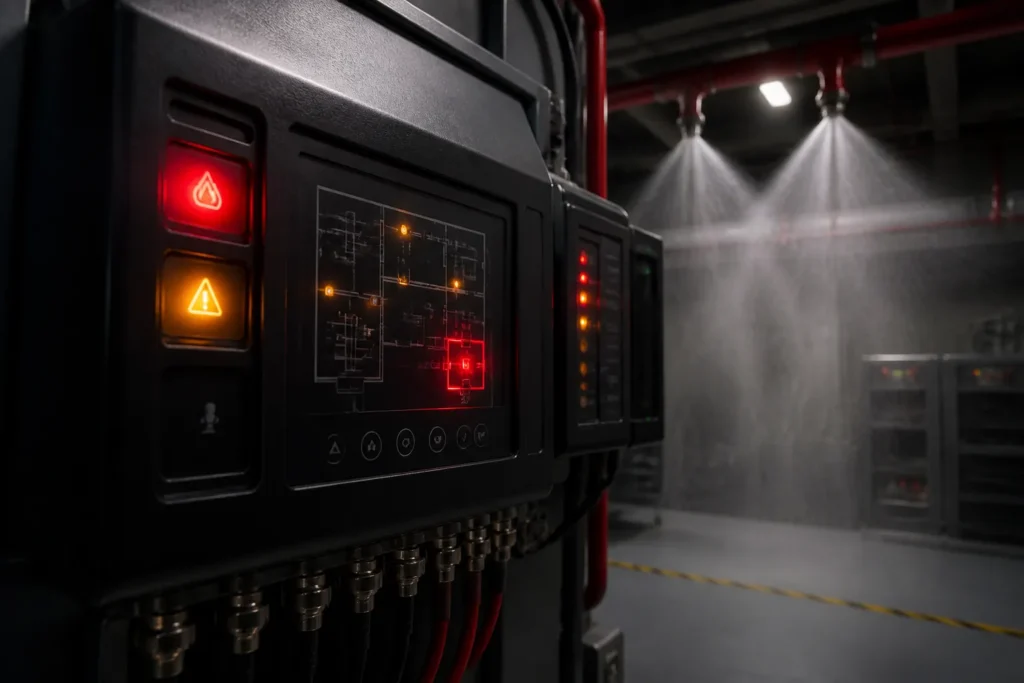
Automatic fire suppression systems are triggered through a sequence of detection, decision, and activation. A detection device like a heat-sensing cable or smoke detector identifies a fire and sends a signal to a control panel. This panel then processes the signal and activates the connected aerosol fire extinguishers, either instantly or after a programmed delay. Manual activation points also allow for human intervention.
What Are the Key Stages in an Automatic Activation Sequence?
An automatic fire suppression system relies on a clear, three-stage process to function reliably. Understanding this sequence is crucial for designing an effective fire safety solution for any environment. The system functions as a cohesive unit where each part plays a critical role in protecting assets and ensuring safety.
- Detection: The first stage involves one or more sensors detecting the initial signs of a fire. This could be a rapid rise in temperature, the presence of smoke, or specific gas signatures. The type of detector is chosen based on the most likely fire risk in the protected area.
- Decision (Control): The signal from the detector is sent to a fire extinguishing control panel. This panel acts as the brain of the system. It verifies the signal, manages any pre-set time delays, activates alarms like sounders and beacons, and ultimately sends the command to activate the suppression units.
- Activation (Suppression): Upon receiving the command from the control panel, the aerosol extinguishing units are activated. They rapidly discharge a fine aerosol that chemically interrupts the fire’s chain reaction at a molecular level, extinguishing the flames without depleting oxygen or causing significant collateral damage.
How Do Different Fire Detection Methods Compare?
The choice of detection method is critical for a fast and reliable response. Different technologies are suited to different environments and potential fire types. For example, a slow, smouldering fire is best detected by smoke, while a fast-developing flame in machinery is better caught by heat detection. You can explore a variety of detection device instruction videos to see how they are installed.
| Detection Method | What It Senses | Response Character | Control Panel Required? | Typical Application |
|---|---|---|---|---|
| Linear Heat Detection (LHD) Cable | Heat at any point along the cable | Triggers when a specific temperature is reached, ideal for covering long distances or complex equipment layouts. | Yes | Electrical cabinets, parking garages, industrial machinery. |
| Bimetal Switch | Heat at a specific point | A simple, robust switch that activates at a fixed temperature. Often used for direct, localised protection. | Not always; can trigger a unit directly. | Small enclosures, engines, specific components within larger machinery. |
| Smoke Detector Loop | Visible or invisible smoke particles | Provides very early warning for smouldering fires before significant heat or flames develop. | Yes | IT & server rooms, technical rooms, control rooms. |
What is the Role of a Fire Extinguishing Control Panel?
A fire extinguishing control panel, such as a DECU3 unit, serves as the central command hub for the suppression system. It does more than just receive a signal and activate an extinguisher. Its key functions include:
- System Monitoring: It continuously supervises the detection circuits and extinguishing units for faults or disconnects, ensuring the system is always ready.
- Alarm Management: The panel activates audible alarms (sounders) and visual alerts (beacons) to warn personnel of an impending discharge.
- Programmed Delays: In occupied areas, a delay can be programmed between the initial alarm and the aerosol discharge to allow for evacuation.
- Manual Control: It provides inputs for manual call points and activation/delay buttons, giving operators override capabilities.
- Communication: The panel can relay its status to a central building management system or fire alarm panel, providing integrated facility-wide monitoring.
You can see how various fire extinguishing control panels are configured in our video library.
How Fast Do Aerosol Extinguishers Activate and Discharge?
Once the activation command is given, the aerosol generators deploy their extinguishing agent with remarkable speed. This rapid discharge is essential for knocking down a fire in its earliest stages, preventing it from growing and spreading. The compact AF-X Fireblocker NANO series, for example, is designed for quick suppression in enclosed spaces.
| Model | Aerosol Mass | Max. Protection Volume | Discharge Time | Max. Install Height | Dimensions (L x Ø) |
|---|---|---|---|---|---|
| CXXS | 30 g | 0.4 m³ | Under 20 seconds | 1.5 m | 18 x 3.8 cm |
| CXS | 60 g | 0.8 m³ | Under 40 seconds | 2.0 m | 18 x 3.8 cm |
What Information Is Needed to Specify a System?
When requesting a quotation or system design, providing detailed information ensures the proposed solution is effective and compliant. Be prepared to share the following:
- Room Dimensions: The exact length, width, and height of the protected space to calculate the required volume.
- Type of Risk: The specific assets being protected (e.g., lithium-ion batteries, switchgear, servers, diesel engines).
- Environmental Conditions: Factors like temperature ranges, humidity, and the presence of dust or corrosive elements.
- Certification Requirements: The system must meet all relevant international and local standards. The AF-X Fireblocker holds certifications including ISO 15779, EN 15276, NFPA 2010, UL 2775, and KIWA, as well as marine-specific approvals like IMO MSC/Circ.1270. You can review our full list of compliance and certificates for more details.