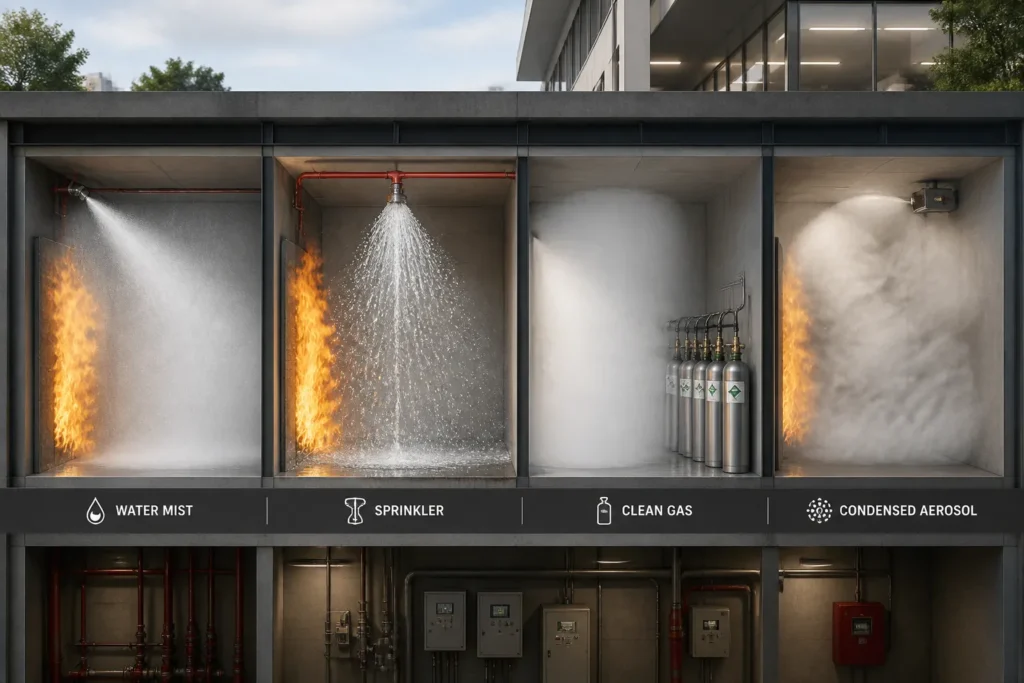
Choosing a fire suppression system involves comparing key trade-offs. Condensed aerosol systems offer a waterless, unpressurised solution with a minimal footprint and long lifespan, ideal for sensitive equipment. Traditional sprinklers are cost-effective for general coverage but cause significant water damage. Clean gas systems leave no residue but require pressurised cylinders and sealed rooms. Water mist reduces water usage but requires high pressure and complex piping, occupying a middle ground.
How do fire suppression systems compare on key criteria?
Selecting the optimal fire suppression technology depends entirely on the application. A data centre has vastly different protection needs from an industrial warehouse or a wind turbine. Key decision criteria include the potential for collateral damage from the extinguishing agent, the system’s physical footprint and infrastructure needs, safety for personnel, and long-term operational costs. Below is a detailed comparison of the four leading system types: condensed aerosol, water sprinklers, clean agent gas, and water mist.
| Criterion | Condensed Aerosol | Water Sprinkler | Clean Agent Gas | Water Mist |
|---|---|---|---|---|
| Water Damage | None | High | None | Low |
| System Pressure | Unpressurised | Moderate (6-12 bar) | High to Very High (25-300 bar) | High to Very High (35-200 bar) |
| Piping Requirement | None required | Extensive network | Required | Required (often special grade) |
| Space Footprint | Minimal (compact generators) | Very Large (pumps, water tanks) | Large (cylinder bank, dedicated room) | Moderate (pump skid, small tank) |
| Post-Discharge Residue | Minimal, dry particulate | Water | None | Minimal water moisture |
| Oxygen Impact on People | None; does not affect oxygen levels | None | Varies: Inert gases reduce O2 to 12-15%; chemical gases have minimal impact | None |
| Maintenance Regime | Simple, visual inspection | Complex; annual flow tests, inspections | Complex; cylinder weighing, room integrity tests | Complex; nozzle checks, pump tests |
| Certified Lifespan | 15+ years | 20-25 years (with component replacement) | Cylinders require hydrostatic testing every 5-10 years | 20+ years (with component replacement) |
Which systems cause the least collateral damage?
Both condensed aerosol and clean gas systems excel at protecting high-value assets because they are waterless. They extinguish fires without causing the electrical shorts, corrosion, or widespread water damage associated with sprinklers. Condensed aerosol, such as potassium-based systems from manufacturers like AF-X Fireblocker, leaves behind a fine, non-corrosive particulate that can be cleaned with a vacuum or dry cloth. Clean gas systems leave no residue at all. Water mist systems significantly reduce water damage compared to sprinklers—using up to 90% less water—but still introduce moisture into the environment.
What are the installation and infrastructure differences?
Installation complexity and space requirements vary dramatically. Water sprinklers, water mist, and gas systems all require extensive networks of piping, along with significant floor space for pumps, water tanks, or heavy, pressurised cylinders. These cylinders often must be housed in a separate, dedicated room. In contrast, condensed aerosol systems are modular and unpressurised. They consist of compact generators installed directly within the protected space, requiring only electrical wiring for activation. This eliminates the need for piping, pressure vessels, or structural reinforcements, making them ideal for retrofitting and for protecting small, enclosed spaces like electrical cabinets or machinery.
How do the systems impact human safety?
In normally occupied spaces, the impact on oxygen levels is a critical safety concern. Water-based systems (sprinklers and mist) and condensed aerosol systems do not lower ambient oxygen levels. Aerosol technology works by chemically interrupting the fire’s chain reaction at a molecular level, leaving oxygen unaffected. Some clean gas systems, specifically inert gases (like Nitrogen or Argon), work by displacing oxygen to a level (around 12-15%) that will not support combustion but is considered safe for brief human exposure. Chemical gas agents and aerosol are generally considered safe for use in occupied areas, as they do not work by oxygen displacement.
What determines the total cost of ownership?
The total cost of ownership extends beyond the initial purchase price to include installation, maintenance, and lifespan. While sprinklers may have a lower initial cost for large, open areas, they require frequent and intensive maintenance. Gas and water mist systems involve high installation costs due to piping and infrastructure, plus ongoing maintenance like cylinder weighing, pressure checks, and nozzle inspections. Condensed aerosol systems, certified to standards like ISO 15779, EN 15276, and UL 2775, feature a long certified lifespan of 15 years or more and require only simple visual maintenance, resulting in a significantly lower lifetime cost. The absence of pressurised parts or complex plumbing reduces both maintenance needs and the risk of accidental discharge. To understand more about innovative suppression solutions, explore this overview of alternatives to traditional systems.