How does the installation of an alternative fire suppression system work?
You want an alternative to sprinklers or gas suppression, but you also want to know what the installation will actually look like on your site: downtime, safety, testing, and handover. With our AF-X Fireblocker condensed aerosol system, installation is typically simpler because it is pressureless, waterless, and doesn’t require piping or gas-cylinder rooms. Lees het overzichtsartikel over Who offers an alternative to sprinkler or gas suppression systems? In this article we explain the installation process step-by-step, how to prepare, and how commissioning and testing work in practice.
How does the installation of an alternative fire suppression system work?
Installing an alternative fire suppression system starts with one principle: protect the fire sources where ignition is most likely, so we can extinguish at the origin and limit consequential damage. In industrial environments, the most common causes are short circuits and overheating, and they usually occur in just a few specific locations—think control technology, control cabinets, and electrical cabinets. That is why we often design AF-X Fireblocker protection “at the source” using compact aerosol generators, and—when needed—use larger generators to secure areas like production, technical, server, and storage zones.
Because AF-X Fireblockers extinguish without water and without oxygen expulsion (gas), the system is inherently different from sprinklers and traditional gas systems. Our aerosol works at molecular level: it encapsulates oxygen molecules so the fire can no longer use oxygen, while oxygen remains present in the room for breathing. This approach also means fewer infrastructure requirements compared to piping networks and pressurised cylinders.
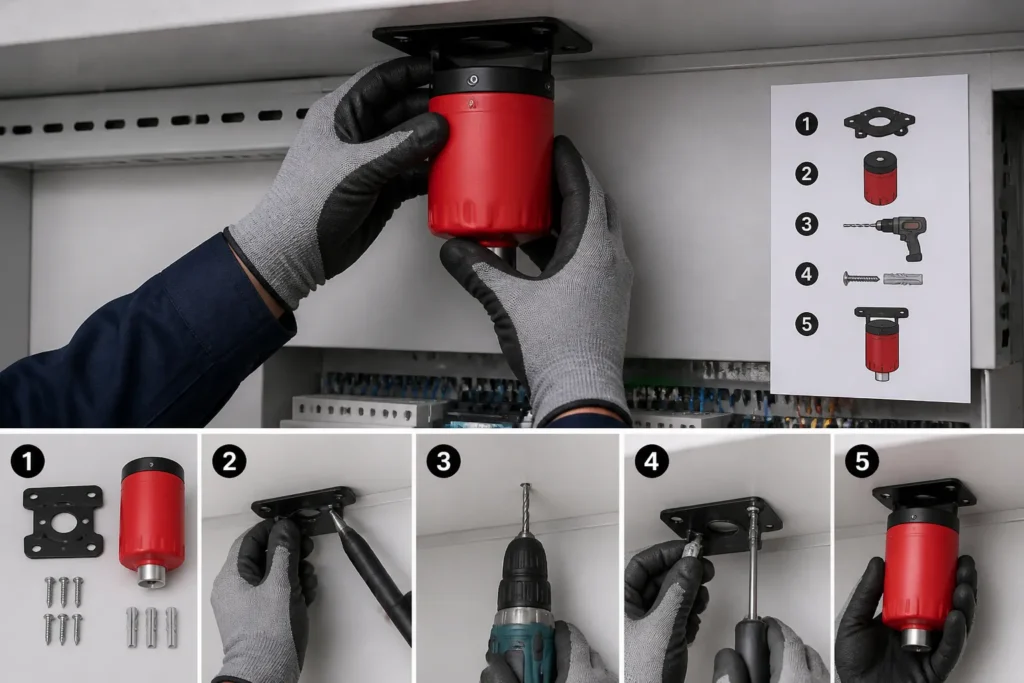
What are the steps of the installation process?
- Scope & risk mapping: we identify the compartments/objects to protect (e.g., electrical cabinets, technical rooms, production areas) and align on goals like minimizing fire damage and preventing business interruption.
- System design: we select generator sizes (small “source protection” vs larger “area protection”) and determine placement for effective distribution in the protected volume/object.
- Pre-install check: we confirm the physical mounting points, activation interfaces, and any site constraints. Because our system is pressureless and compact, structural changes are often limited.
- Mounting & wiring: the generators are installed and connected to the chosen detection/activation logic. Our approach is built around simplicity and “Plug & Play, Compact.”
- Integration: we connect alarms, shutdown signals (where relevant), and operational interlocks that you require for your processes.
- Commissioning & handover: we perform acceptance checks, provide documentation, and align maintenance planning.
What preparations do I need to make for installation?
Preparation is mostly about access and clarity. Ensure we can safely access the protected cabinets/rooms, agree on working hours, and identify any production constraints. One practical advantage: AF-X does not require special conditions such as water-pressure, water-access, or water-storage, and you don’t need a separated room for gas cylinders or extensive piping. That typically reduces pre-work and coordination across multiple contractors.
- Provide drawings or a walkdown of the areas/objects to be protected.
- Confirm who owns electrical isolation/LOTO on-site.
- Plan temporary access to ceilings, cabinets, or technical areas where generators will be mounted.
- Align on notification strategy (alarms, signage, and staff briefings).
How does testing and commissioning work?
Commissioning focuses on proving correct installation and safe operation without disrupting your business. We verify mounting, wiring, and control logic; check alarm interfaces; and confirm that the system matches the defined protection scope (object/area). We also validate that operational measures—like shutdown outputs for certain equipment—work as intended. Finally, we complete handover with clear instructions for day-to-day operation and maintenance planning. Because the system is designed to be easier to maintain than traditional systems, commissioning is usually straightforward, with fewer dependencies on complex piping or cylinder pressure checks.
Why do I want to know how the installation will go?
You’re not just buying hardware—you’re managing risk, continuity, and people. In industrial settings, business continuity is essential, and the installation phase is where avoidable issues (unexpected downtime, access conflicts, safety confusion) can undermine the value of the upgrade. Understanding the process helps you set expectations internally and make the right calls early.
I want to be sure the installation is problem-free—what helps most?
Clarity on scope and responsibilities is what prevents friction. Decide upfront which areas are protected “at the source” (for example, electrical cabinets and control cabinets) and which zones require area coverage (production, technical, server, storage). Then assign owners for access, power isolation, and change approvals. Our systems are designed to be easy and fast to install and to avoid special conditions (no water pressure, no piping, no gas-cylinder room), which reduces the number of potential blockers during execution.
Do I need to prepare staff for the new system?
Yes—especially operators, facility teams, and safety officers. Your team should understand what the system is (waterless, without gas/oxygen expulsion), where the protected compartments are, what alarms/notifications mean, and what to do when the system triggers. This is also the moment to align on how you communicate an incident and how you resume operations after an activation.
What safety measures matter during installation?
Safety is about controlled access, correct electrical isolation, and clear separation of “live” production from installation work. We recommend standard controls such as permit-to-work where required, lockout/tagout for cabinets, and ensuring no unauthorized personnel enter the work zone. Because our solution is pressureless and does not involve water piping or gas cylinders, you avoid some hazards associated with high-pressure storage and extensive pipework—yet you still need disciplined site safety.
How do I prepare optimally for installing a new system?
Optimal preparation means you minimize operational impact while maximizing installation quality. The goal is a successful commissioning that matches your risk profile and keeps your plant running with minimal disruption.
Which internal procedures should I update?
- Fire response plan: include actions specific to aerosol-based suppression (notifications, access restrictions, restart criteria).
- Maintenance planning: add periodic checks aligned to the installed configuration. AF-X systems are designed for low installation and maintenance costs due to their simplicity.
- Change management: document protected assets (cabinets/rooms) so future modifications don’t unintentionally reduce coverage.
- Training & briefings: ensure facility and shift teams know what changes and what stays the same.
How can I minimize impact on operations?
Schedule work around production peaks and isolate by zone. Because we often protect only a few key fire sources (where short circuits/overheating are most likely), you can frequently stage installation cabinet-by-cabinet or room-by-room. Prepare access in advance (keys, escorts, safe platforms), and agree on short, controlled outage windows for any required electrical work. This staged approach keeps most of your plant operational while improving fire safety at the most critical points.
Best practices for a successful installation
- Start with the ignition sources: prioritize control and electrical cabinets for immediate risk reduction and minimal consequential damage.
- Keep the design simple: leverage the compact, Plug & Play nature of our system to avoid unnecessary complexity.
- Align on acceptance criteria: define what “ready for use” means (alarms, shutdowns, documentation, training) before work begins.
- Document everything: protected volumes/objects, generator locations, wiring routes, and interface points for future audits and changes.
If you want to better understand the suppression principle behind our installation choices, read: How aerosol extinguishing works.
Conclusion
Installing an alternative to sprinklers or gas systems becomes manageable when you break it into clear phases: scope, design, mounting and integration, and commissioning. With AF-X Fireblocker, you benefit from a waterless, pressureless approach that avoids oxygen expulsion and typically reduces infrastructure requirements such as piping, water storage, or gas-cylinder rooms. Next step: map your highest-risk ignition sources (often electrical and control cabinets), plan access and outage windows, and align internal procedures for response and maintenance. For real-world examples, explore our case studies and contact us to scope your installation.