Which alternative fire suppression services and options can I buy instead of sprinklers or gas systems?
If you’re comparing sprinklers or gas suppression with newer alternatives, you’re usually trying to solve one problem: stop a fire fast, with minimal collateral damage and minimal downtime. That is exactly where condensed aerosol fire extinguishing fits. Lees het overzichtsartikel over Who offers an alternative to sprinkler or gas suppression systems? In this article we’ll show you what you can actually buy from us (system options), what typically drives total cost (installation and maintenance), and which services you should expect around design, compliance, and commissioning.
Which alternative fire suppression services and options can I buy?
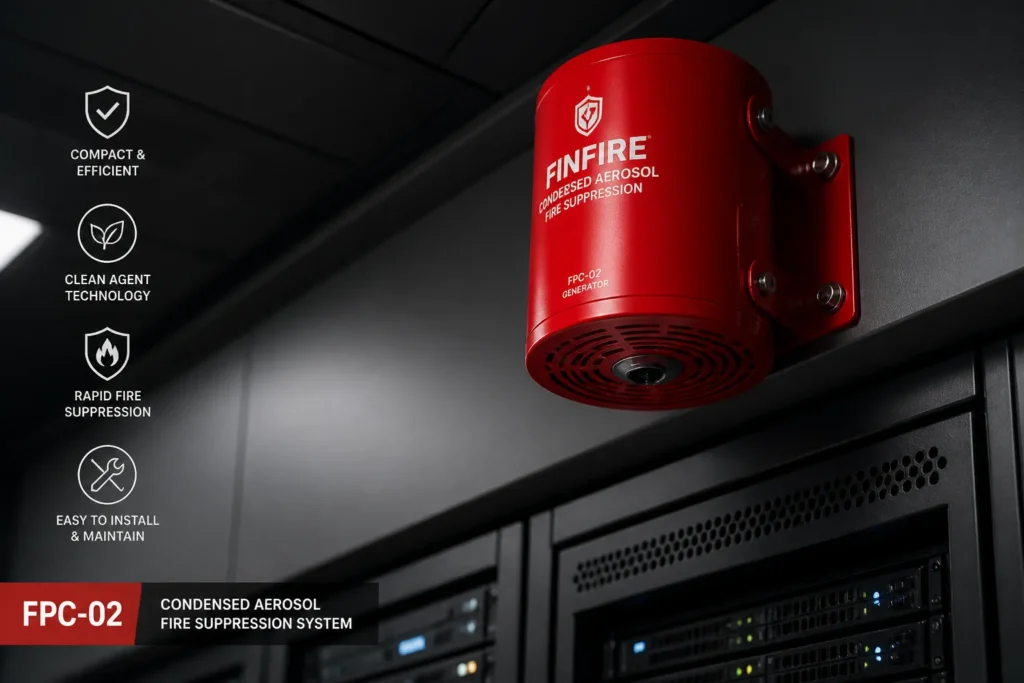
With AF-X Fireblocker you buy a waterless, pressureless aerosol fire extinguishing solution that blocks the fire at its origin—without oxygen expulsion (gas) and without water. In practical terms, that means you can protect either the source (where fires usually start) or the space (where you want full-room coverage), using compact aerosol generators that activate when needed and suppress the fire at molecular level by encapsulating oxygen molecules (without removing breathable oxygen from the room).
What “packages” are available for different systems?
We typically deliver solutions in two clear system approaches, which you can see across our application range:
- Source protection (small generators): Ideal for control technology, control cabinets and electrical cabinets—places where short circuits and overheating often initiate a fire. This approach aims to keep damage limited to the component that caused the incident.
- Area protection (larger generators): Designed to secure larger zones such as production areas, technical areas, server areas and storage areas—where you need coverage of an entire room or compartment.
Because we apply the same core technology across multiple risk environments, we can tailor a configuration for industrial environments, technical rooms, electrical cabinets, IT & server rooms, marine, wind turbines, offshore, lithium-ion energy storage (ESS/BESS), and fully automatic (closed) parking garages. You can explore the relevant applications here: Applications.
What are the costs for installation and maintenance?
Exact pricing depends on risk volume, compartmentation, activation method, and the number/size of generators. That said, our cost model is structurally different from sprinklers and gas systems:
- Lower installation cost drivers: Our system is plug & play, compact, and typically requires no piping, no separate cylinder room, and no special conditions such as water pressure, water access, or water storage. In many cases, this means no structural building adjustments.
- Lower maintenance complexity: The simplicity of the system makes it easier to maintain than traditional systems, which often reduces recurring service time and site disruption.
- Long service life: A typical AF-X Fireblocker solution is designed around a 15-year life-span, supporting predictable long-term planning.
As a result, the purchase of an AF-X system is in many cases cheaper than other fire extinguishing systems, while also reducing installation and maintenance effort.
Which additional services are commonly included?
When you buy an alternative suppression solution, the hardware is only part of the outcome. In most projects we support you (directly or via our distributors) with:
- Risk and application scoping: deciding between source vs. area protection, and defining the compartments you want to protect.
- System design support: generator selection and placement logic based on the protected object/volume.
- Compliance alignment: guidance around certificates and required documentation for your site and insurer (see Compliance and Certificates).
- Commissioning support: ensuring the system is installed as designed and ready for operational handover.
- Lifecycle support: maintenance planning consistent with your operational and safety requirements.
Why am I considering alternatives to traditional suppression systems?
If your business depends on uptime, traditional systems can introduce trade-offs: water damage risk, infrastructure requirements, oxygen-expelling gas constraints, and complicated installation. We built AF-X Fireblocker for a different priority set: stop the fire early, limit consequential damage, and protect business continuity.
Better property protection often comes down to one principle: protect the places where fires actually start. In industrial settings, short circuits and overheating typically happen in only a few locations. By securing those sources—like electrical cabinets, control technology, or high-risk equipment—you reduce both the likelihood of spread and the size of the incident. Because the aerosol works at molecular level by encapsulating oxygen molecules (without expelling oxygen), suppression can be effective without turning the room into a low-oxygen environment.
Long-term cost savings are usually a combination of lower CAPEX and lower operational friction. Our solution is pressureless, waterless, and compact, which can reduce structural changes and speed up installation. Over time, easier maintenance and a 15-year lifespan can reduce total cost of ownership compared with systems that rely on piping networks, water supply infrastructure, or gas cylinder logistics.
Sector-specific benefits are especially clear where collateral damage is expensive: technical rooms, server rooms, industrial production zones, offshore and marine environments, wind turbines, and lithium-ion energy storage (ESS/BESS) setups in buildings, containers and cabinets. In these sectors, “putting the fire out” isn’t enough—limiting downtime and secondary damage is often the real win.
Which alternative suppression service fits my situation?
To choose the right alternative to sprinklers or gas systems, you’ll get the best result by making the decision criteria explicit and then mapping them to your building and operational needs.
Key criteria to decide
- Target: Do you need source protection (cabinets, control panels, equipment hotspots) or area protection (whole rooms/compartments)?
- Collateral damage tolerance: How costly is water damage, cleanup, corrosion, or long downtime?
- Infrastructure constraints: Can you provide water pressure/storage, piping routes, or a cylinder room? If not, a compact plug & play approach can be decisive.
- People and operations: Do you require a solution that does not expel oxygen from the room as part of its extinguishing method?
- Environment and sustainability: Our aerosol solution has zero ozone depletion potential and zero global warming potential, with negligible atmospheric lifetime.
How to determine suitability for your building
- List your ignition sources: identify cabinets, converters, drives, UPS, switchgear, battery racks/containers, and other heat/short-circuit prone assets.
- Define compartments: decide where you want to limit fire spread (single cabinet, technical room, production zone, server room).
- Choose the approach: small generators for objects/sources; larger generators for rooms/areas.
- Validate constraints: check whether you want to avoid water and oxygen expulsion and whether you lack infrastructure for traditional solutions.
- Align compliance: confirm documentation and certification expectations early with your safety team, insurer, and authorities.
Questions you should ask us (or any provider)
- Which hazards are you designing for in my sector (electrical faults, overheating, lithium-ion thermal events, etc.)?
- Is the proposal designed for source protection, area protection, or a hybrid—and why?
- What installation prerequisites exist (piping, water supply, cylinder rooms), and which are avoided?
- What is the expected maintenance scope, service interval approach, and impact on operations?
- What is the stated system life-span (we design around 15 years) and what replacements are expected?
- Which compliance documents and certificates will be provided for my project?
Next steps: shortlist the compartments you want to protect, decide whether you need source protection or area protection, and then contact us with your application details so we can route you to the right solution path (directly or via our distributor network).
Conclusion
If you want an alternative to sprinklers or gas suppression, condensed aerosol suppression is often the most practical route: it is waterless, pressureless, and does not rely on oxygen expulsion—while still targeting the fire at its origin to reduce consequential damage. In many cases you’ll benefit from lower installation and maintenance costs, plus a 15-year lifespan for predictable lifecycle planning. Review our application areas to see what fits your environment, then align on compliance requirements and a design approach (source vs. area protection) to move toward a scoped proposal.