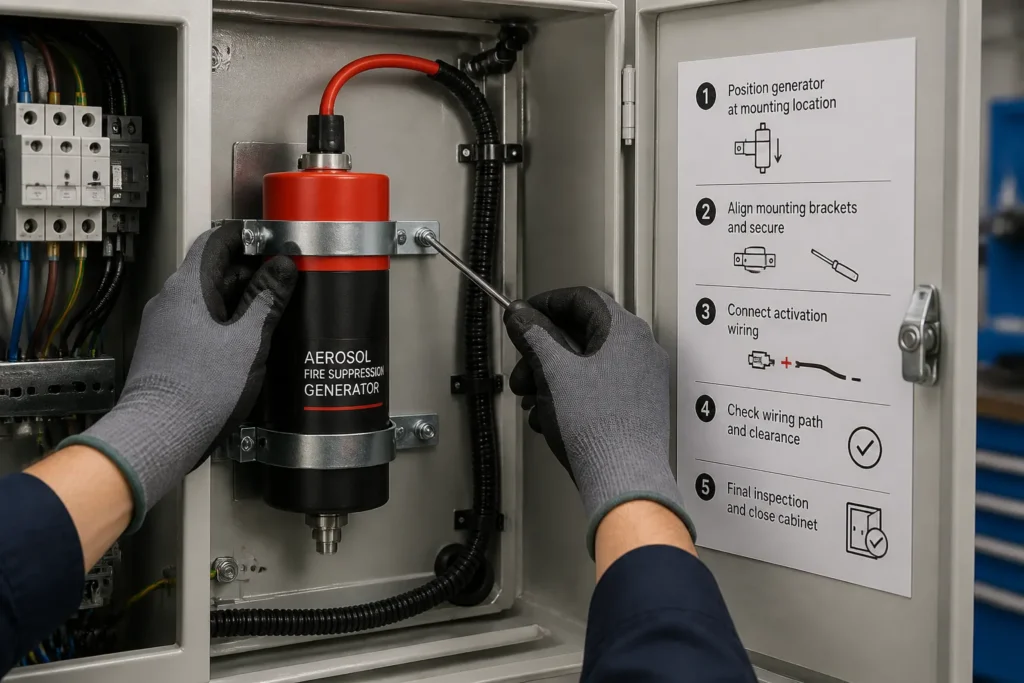
How does the installation process of an aerosol fire suppression system work?
You want certainty: if a fire starts, will the system activate correctly and stop it at the source? In this guide we explain exactly how installation works for an aerosol fire suppression system, what you need to prepare, and what to expect on-site. Lees het overzichtsartikel over Which company supplies an aerosol fire suppression system?
How does the installation process of an aerosol fire suppression system work?
At AF-X Fireblocker, we design aerosol fire extinguishing systems to block a fire at its origin. Our generators contain a solid aerosol-forming compound inside a non-pressurized generator. When triggered, an electrical ignitor initiates a controlled transformation: the solid compound rapidly becomes an extinguishing aerosol, passes a cooling section, and exits through the outflow opening. A grid at the outflow side supports gradual distribution of the aerosol in the protected volume. The system can be activated automatically via thermal or smoke detection or manually, depending on your risk profile and operating requirements.
Step-by-step: what happens during installation?
-
Site survey and risk definition
We start by defining what you are protecting (for example electrical cabinets, technical rooms, industrial areas, IT & server rooms, marine spaces, wind turbines, offshore areas, lithium-ion ESS/BESS rooms or containers). This step determines protected volume, ignition scenarios, and how the extinguishing aerosol should distribute in your enclosure. -
System design and activation concept
We decide how the generators will be activated: automatically (smoke/thermal detection) and/or manually. We also define the electrical control and activation mechanism, because our generators have a connector for electrical control. This is where we align with your fire alarm system, local shutdowns, door contacts, ventilation logic, or equipment interlocks. -
Mounting the aerosol generators
We install the generators in the intended enclosure/space so the aerosol can flow with natural convection and reach the fire area quickly. Placement is about real-world obstacles (cable trays, racks, machinery), access for service, and correct orientation of the outflow opening for distribution. -
Electrical connection and integration
Next, we connect each generator to the control/activation circuit. Because activation is initiated by an electrical impulse, wiring integrity, correct circuit design, and clear labeling are essential. We verify correct signal paths for automatic detectors and manual release devices. -
Commissioning checks
We test the detection and release logic (without discharging). We verify power supply, fault monitoring, and that manual and automatic activation behave exactly as agreed. We also review the room readiness assumptions (for example: enclosure boundaries, openings, ventilation behavior during discharge). -
Handover: documentation and user instructions
You receive the agreed documentation set and practical instructions for daily use: what “normal” looks like, what alarms mean, and what to do after an activation.
What preparations should you make before installation?
Installation goes fastest when you prepare three things:
-
Access and safety: ensure site access, work permits, lockout/tagout rules, and a safe working area around the protected enclosure (cabinet/room/container).
-
Infrastructure readiness: confirm mounting surfaces, cable routes, penetrations, and a clear location for detectors and manual release devices. Make sure the control panel location and power supply are defined.
-
Operational interfaces: agree on what should happen on release (for example: shutdown of equipment, stopping ventilation, or notifying monitoring). This avoids last-minute changes during commissioning.
How long does installation take?
Timing depends on enclosure size, number of generators, and integration complexity (detectors, manual release, and connections to your fire alarm/BMS). As a rule, a straightforward cabinet or small room installation is typically completed faster than a multi-zone industrial setup with multiple interlocks and site permit constraints. The best way to predict the timeline is to define scope early (number of spaces, detection type, integration points) so we can plan the on-site work efficiently and reduce downtime.
Why is it important to understand the installation process?
Understanding the process is not “nice to have”—it directly impacts reliability, safety, and continuity. Our aerosol extinguishing principle stops the combustion reaction on a molecular basis by binding free radicals, rather than suffocating by oxygen removal or cooling. That means your enclosure behavior, airflow patterns, and activation logic matter. When you know what is being installed and why, you can make better decisions about detectors, interlocks, and maintenance planning.
There are three practical benefits:
-
Fewer surprises during commissioning: you know which inputs and outputs must be tested (automatic detection, manual activation, fault monitoring) and you can ensure stakeholders are available when required.
-
Better preparation and less downtime: when cable routes, mounting locations, and shutdown windows are ready, the installation team can focus on quality rather than improvisation.
-
Clear expectations during installation: you’ll recognize the key moments—mounting, electrical integration (activation by electrical impulse), and logic testing—so you can validate that the delivered system matches your risk plan.
It also helps you evaluate whether an aerosol system fits your application and operational constraints. If you want to dive deeper into how the agent behaves and why it remains effective in the protected space, read: How does an aerosol extinguishing agent work?
How can you prepare optimally for installing an aerosol system?
Use this preparation checklist to make installation smooth and predictable.
1) Documents and permits you typically need
-
Scope description: what areas are protected, what hazards exist (e.g., lithium-ion ESS/BESS, electrical cabinets, technical rooms), and what success criteria you use (shutdown requirements, monitoring requirements).
-
Site permits and safety documents: work permits, access approvals, LOTO procedures, hot-work rules (if applicable), and local contractor induction requirements.
-
Compliance evidence: when your internal or local authority process requires it, use our references and compliance materials. Start here: Compliance and Certificates.
2) How to ensure a smooth installation
-
Freeze the activation concept early: decide on thermal/smoke detection, manual release, and which equipment must shut down on activation.
-
Prepare the enclosure: confirm boundaries, penetrations, doors, and ventilation behavior. If the space is being modified (new racks, new cable trays), do it before commissioning.
-
Plan stakeholders: have your EHS, facilities, and (if applicable) fire alarm contractor available for testing and sign-off. Delays often come from waiting for the right person to approve an interface.
3) Best practices for using an aerosol fire suppression system
-
Train on “what to do after activation”: define who isolates equipment, who inspects the enclosure, and how you document the event.
-
Maintain detection and release readiness: your system is only as reliable as its detection and electrical activation chain. Keep detectors clean, verify fault signals, and ensure manual release points stay accessible.
-
Design for the fire you actually fear: for high-impact scenarios (like lithium-ion installations or mission-critical IT rooms), align interlocks, notifications, and operating procedures with business continuity goals—not just code minimums.
If you want support choosing the right setup for your environment (industrial, electrical cabinets, marine, offshore, wind turbines, ESS/BESS), contact us via our contact page and we’ll help you map risks to an installation plan.
Conclusion
Installing an aerosol fire suppression system is primarily about getting three things right: correct generator placement for effective aerosol distribution, robust electrical activation (because discharge starts with an electrical impulse), and reliable detection/manual release logic. When you understand the steps and prepare access, infrastructure, and documentation in advance, installation becomes predictable and downtime stays low. Want to move forward? Share your application details and we’ll help you define the activation concept, documentation set, and a practical installation timeline.