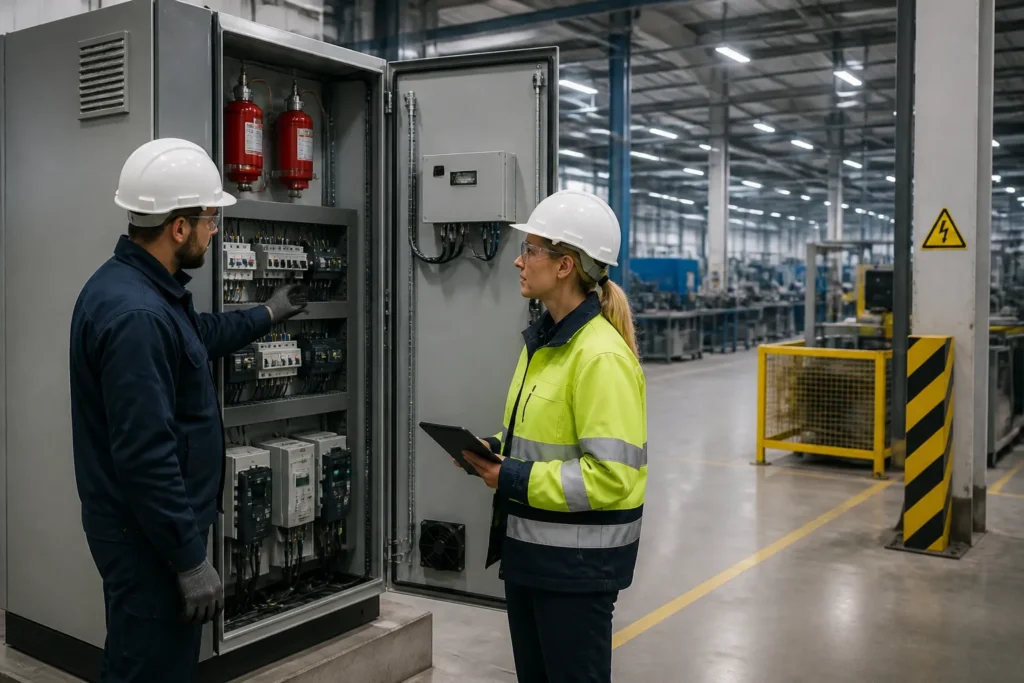
Effective business fire prevention requires a team of specialists. Risk assessors identify hazards, installers set up detection and suppression systems, and service companies provide ongoing maintenance. Technology providers, like AF-X Fireblocker, develop and supply suppression technology through a network of distributors and installers, as one part of a fire safety strategy developed for the specific site.
What Are the Key Roles in Commercial Fire Prevention?
Creating a robust fire safety plan for a commercial property involves several distinct professional services. Each provider has a specific role, and understanding their function is crucial for ensuring complete coverage. From initial planning to long-term maintenance, these experts work together to protect your assets and personnel. For a complete overview, see our main article on business fire prevention and protection.
| Provider Type | What They Deliver | When You Need Them | What They Typically Do Not Do |
|---|---|---|---|
| Risk Assessor / Consultant | A detailed fire risk assessment report, safety strategy, and compliance recommendations. | Before designing or upgrading a fire safety system, or for periodic compliance reviews. | Install systems or manufacture suppression components. |
| Alarm & Detection Installer | Installation and commissioning of smoke, heat, and flame detection systems and alarm panels. | To ensure early warning of a fire event as part of a new build or system upgrade. | Conduct the initial high-level risk assessment or design suppression systems. |
| System Contractor (Sprinkler/Gas) | Design, installation, and maintenance of building-wide suppression systems like sprinklers or gas flooding. | For protecting entire rooms or buildings as required by code or insurance. | Manufacture the core system components; confirm the contractor’s scope for individual assets. |
| Extinguisher & Inspection Service | Supply, installation, and routine inspection/maintenance of portable fire extinguishers and safety signage. | For mandatory compliance and providing first-response capabilities for occupants. | Design or install complex, fixed fire suppression systems. |
| Insurer | An insurance policy with specific requirements for fire protection and risk management. | Throughout the lifecycle of the business to ensure financial protection against loss. | Install equipment or carry out routine maintenance; confirm the policy’s technical requirements. |
| System Manufacturer | Certified and tested fire suppression components and systems (e.g., aerosol generators). | When sourcing technology for a new installation or system upgrade via an installer. | Roles vary by supplier; confirm who handles installation, risk assessment and maintenance. |
How Does Building-Wide Protection Differ from Asset-Level Protection?
Commercial fire safety operates on two main levels: protecting the building and protecting specific, high-risk assets within it. The two approaches are complementary, not mutually exclusive.
Building-wide systems, such as sprinklers, are designed to control a fire’s spread throughout a large area, protecting the structure and allowing for safe evacuation. They are essential for general safety and meeting building codes.
Asset-level protection, also known as object or in-enclosure suppression, focuses on extinguishing a fire at its source before it can grow and trigger the building-wide system. This is critical for preventing operational downtime and catastrophic damage to essential equipment. High-risk assets often requiring this focused protection include:
- Electrical cabinets and distribution panels: To stop electrical fires before they spread.
- Technical rooms and MCCs: To protect vital control systems and power infrastructure.
- IT and server rooms: To safeguard data and sensitive electronics from fire and water damage from sprinklers.
- Lithium-ion battery storage (ESS/BESS): To mitigate the unique risks of thermal runaway.
- Automated parking garages: To suppress vehicle fires in confined, high-density spaces.
By stopping a fire inside a cabinet or piece of machinery, asset-level systems can prevent a minor electrical fault from becoming a major incident that halts business operations.
Where Does a Suppression Technology Provider Fit In?
The technology provider is one part of a suppression project, alongside the specialists responsible for design, installation and maintenance. AF-X Fireblocker develops and supplies condensed aerosol suppression technology in cooperation with Aerospace Propulsion Products (APP), part of ArianeGroup.
Our role is to engineer, test, and produce the core components that installers use to build effective fire protection solutions. For a complete project, agree who is responsible for risk assessment, installation, commissioning and maintenance. Our technology is supplied through a network of distributors and certified installers who design and implement systems using our technology.
Our units, developed in partnership with Aerospace Propulsion Products (APP), part of ArianeGroup, are supplied to professionals who integrate them into a complete safety plan. Our compliance page lists product certificates and declarations relating to standards such as ISO 15779, EN 15276, NFPA 2010, UL 2775 and IMO MSC/Circ.1270. Check the relevant product, application and document scope with the project specialist; a listed standard does not by itself establish approval for every installation. You can view our full list of compliance and certificates for more details.