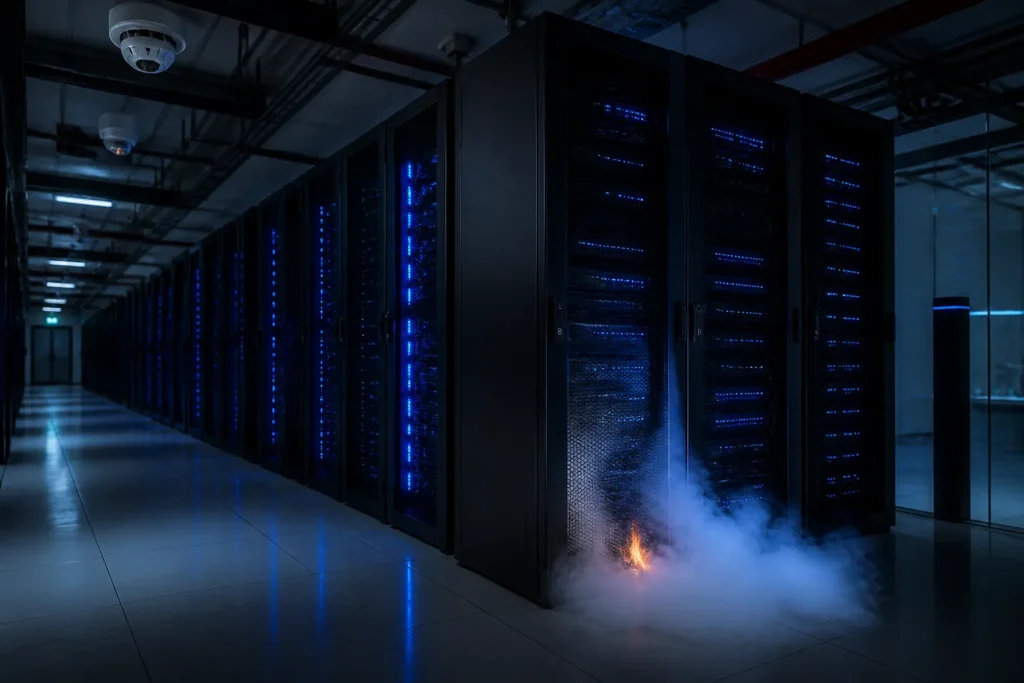
Protecting critical commercial assets like server rooms, Motor Control Centers (MCCs), and Battery Energy Storage Systems (BESS) requires automatic fire suppression that minimises downtime and damage. Condensed aerosol systems offer a certified, waterless, and non-pressurised solution. They extinguish fires at the source without harming sensitive electronics or requiring extensive structural changes, ensuring business continuity and meeting insurer requirements.
A fire in a critical operational area can halt your business instantly, leading to catastrophic financial and data loss. While general fire prevention is a broad topic, the protection of specific, high-value assets demands a specialised approach. Traditional water-based sprinklers can cause as much damage as the fire itself in these environments. Understanding the unique risks of each asset is the first step toward effective and intelligent fire prevention for your business.
Which Assets in Commercial Buildings Are Considered Critical?
In any commercial building, certain areas contain equipment that is essential for operations. A fire in one of these locations creates a single point of failure for the entire business. Key assets requiring specialised protection include:
- MCC & Technical Rooms: These are the nerve centres of a building, housing switchgear, transformers, and control equipment. A fire here can shut down all building operations. Companies like VodafoneZiggo rely on aerosol systems to protect these vital spaces without collateral damage.
- IT & Server Rooms: Data is one of the most valuable assets for any modern business. Automatic suppression in these rooms must be fast, effective, and completely free of water or corrosive agents to protect sensitive electronics and prevent data loss.
- EV Chargers & BESS: With the rise of electric vehicles and on-site energy storage, lithium-ion battery fire safety is a major concern. These fires are difficult to extinguish and can lead to thermal runaway. Aerosol systems are proven to suppress these fires, as demonstrated in installations like the USSC Australia 500 kW BESS Hi-Cube units.
- Automated Parking Garages: High concentrations of vehicles and electrical systems in an enclosed space create significant fire risk. Access for traditional firefighting is often difficult, making automatic, total-flooding suppression systems essential.
Why Choose Condensed Aerosol for Sensitive Environments?
Condensed aerosol technology, developed in partnership with aerospace leaders like Aerospace Propulsion Products (APP), part of ArianeGroup, offers a unique method of fire suppression. Instead of cooling or removing oxygen, it interrupts the fire’s chemical reaction at a molecular level. This makes it exceptionally suited for protecting critical assets.
- No Collateral Damage: The extinguishing agent is a dry, non-corrosive aerosol that leaves minimal residue and is safe for electronics.
- Simple Installation: Systems are compact and modular, requiring no pipework, pressure vessels, or dedicated storage rooms. This dramatically reduces installation time and structural modification costs.
- Low Maintenance & Long Lifespan: AF-X Fireblocker systems have a certified 15-year service life and require only simple visual maintenance, resulting in a very low total cost of ownership.
- Environmentally Safe: The aerosol has zero Ozone Depletion Potential (ODP) and zero Global Warming Potential (GWP), making it a sustainable choice. It does not affect oxygen levels in the protected space.
How Does Aerosol Compare to Gas and Water Systems?
When selecting a fire suppression system for critical assets, it’s important to compare the technologies. Aerosol provides a distinct set of advantages over traditional gas or water-based systems.
| Feature | Condensed Aerosol (AF-X Fireblocker) | Gas Systems (CO2, Novec™, etc.) | Water Sprinkler Systems |
|---|---|---|---|
| Extinguishing Damage | Minimal. A dry, non-conductive agent that is easy to clean. | Low, but high-pressure discharge can damage sensitive hardware. | Catastrophic for electronics and water-sensitive materials. |
| Installation Complexity | Simple and fast. Compact units with no pipes or pressure vessels. | Complex. Requires extensive piping, nozzles, and a separate, large cylinder room. | Very complex. Requires extensive plumbing, pumps, and water storage/supply. |
| Space Required | Minimal. Compact generators are installed directly within the protected space. | Significant. A dedicated, climate-controlled room is needed for cylinders. | High. Requires space for pipes, pumps, and potentially large water tanks. |
| Maintenance | Simple visual checks. 15-year certified service life. | Requires regular cylinder weighing, pressure checks, and hydrostatic testing. | Requires regular flow tests, valve inspections, and corrosion monitoring. |
| Environmental Impact | Zero ODP & GWP. Does not deplete oxygen. | Varies by agent. Some chemical gases have a high GWP. | Risk of contaminated water runoff. High water usage. |
What Certifications Should You Look For in a Suppression System?
To ensure reliability, safety, and acceptance by insurers and authorities, any fire suppression system must meet stringent international standards. Independent, third-party certification validates the system’s performance and manufacturing quality. Key standards for condensed aerosol systems include:
- ISO 15779: International standard for Condensed Aerosol Extinguishing Systems.
- EN 15276: The European equivalent of the ISO standard, a requirement for CE marking.
- NFPA 2010: The US standard for Fixed Aerosol Fire-Extinguishing Systems.
- UL 2775: Underwriters Laboratories standard covering safety and effectiveness for aerosol units.
- KIWA: A respected Dutch certification body providing quality declarations.
Choosing a system that is fully certified to these standards ensures that you are installing a proven, reliable solution that protects your most critical assets and ensures business continuity.